 EN
EN FR
FRHello !
Do you know what makes the wireless home automation protocol viable when you're thinking of transforming a traditional house into a smart home?
Some of them are:
- Wireless communications systems are less expensive to set up because no drilling walls or cables are needed.
- The choice of placement is more flexible than a wired system. You can install wireless devices almost anywhere.
- Wireless devices are easy to reinstall or relocate.
Although there are several wireless home automation communication protocols many of us refer to Wi-Fi as a popular one. If you ask me Wi-Fi is less compatible for this job. And why is that?
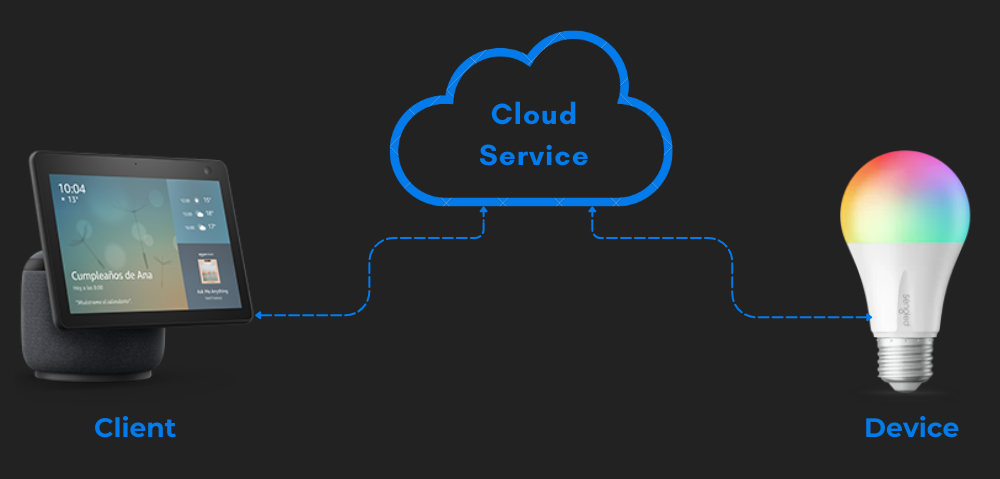
Wi-Fi is presented as a high-bandwidth protocol for transporting large amounts of data wirelessly between two devices, which makes it energy-consuming. Because Wi-Fi consumes more energy, it is less suitable for sensors and other battery-powered devices. Also, when using Wi-Fi, the device services are hosted in the cloud, and the device should always be connected to the cloud.
There are several low-power protocols designed for low-power operation, such as BLE, MQTT, COAP, Z-Wave, Zigbee, LoRAN, etc.
Even though all these wireless protocols have their brilliant features, I'm very much interested in the latest of them: Matter. I'll also be writing another article soon comparing all the wireless home automation protocols and their main features.
Overview :
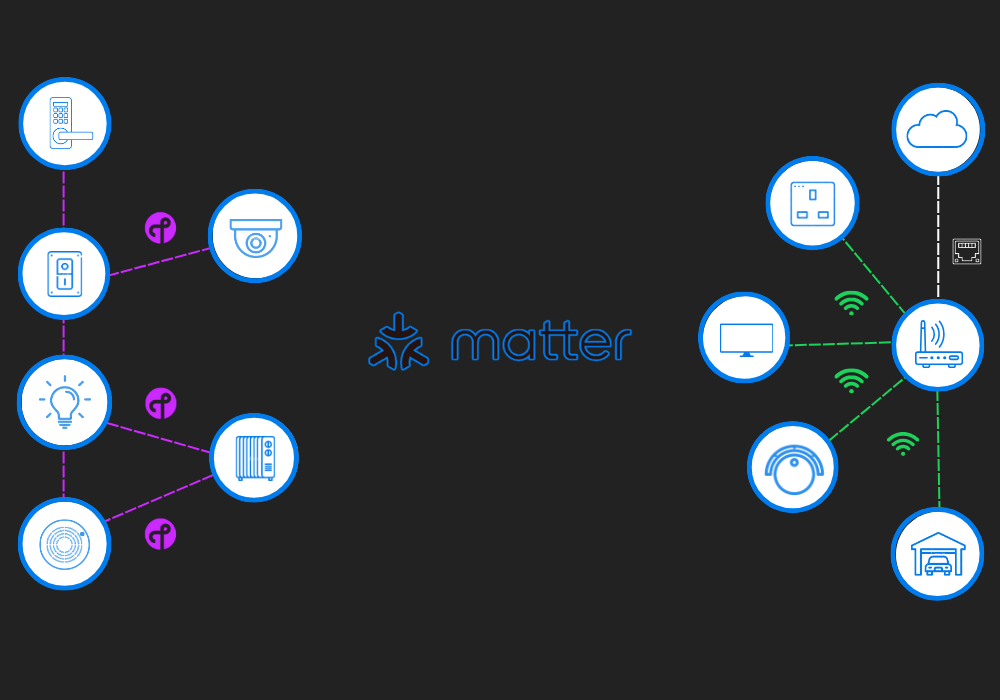
Matter is an open standard, universal IPv6-based protocol for smart homes that allows matter-enabled devices to work with any Matter-certified ecosystem. Hence it allows smart devices from different companies to communicate with each other without any boundaries.
Matter uses the same radio frequency as Zigbee for its operation but uses IPv6 rather than its own network protocol like Zigbee does.
All the well-known voice assistants (Amazon Echo, HomePod & Google Nest Mini/Hub) are compatible with matter (Matter-enabled), as are many other intelligent home devices from hundreds of companies specializing in this field.
The following diagram shows the different stacks of protocol architecture, and we will be concentrating on the Link/Media layer technologies used within matter standard.
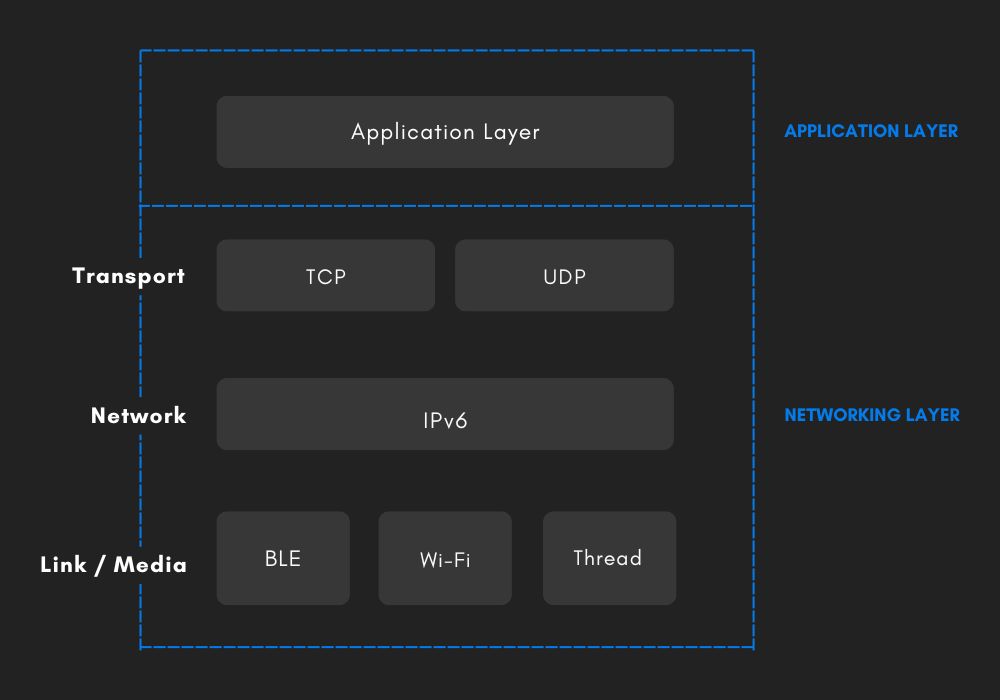
The three link-layer technologies within Matter Standard are BLE, Wi-Fi, and Thread. These link layer technologies make local communication possible by providing IPv6 subnets within the Matter ecosystem. Matter uses BLE only for the initial device setup.
Thread and Matter :
Matter uses Thread as the LLN standard. Thread is an IPv6-based low-power technology that connects low-power and battery-operated smart-home devices. It uses the IEEE 802.15.4 (IEEE standard that defines the operation of a low-rate wireless PAN) wireless protocol with mesh communication, unlike Wi-Fi (Star topology) Thread uses mesh networking. Matter therefore can have a PAN star topology with Wi-Fi as the subnet technology or a mesh topology with Thread as the subnet.
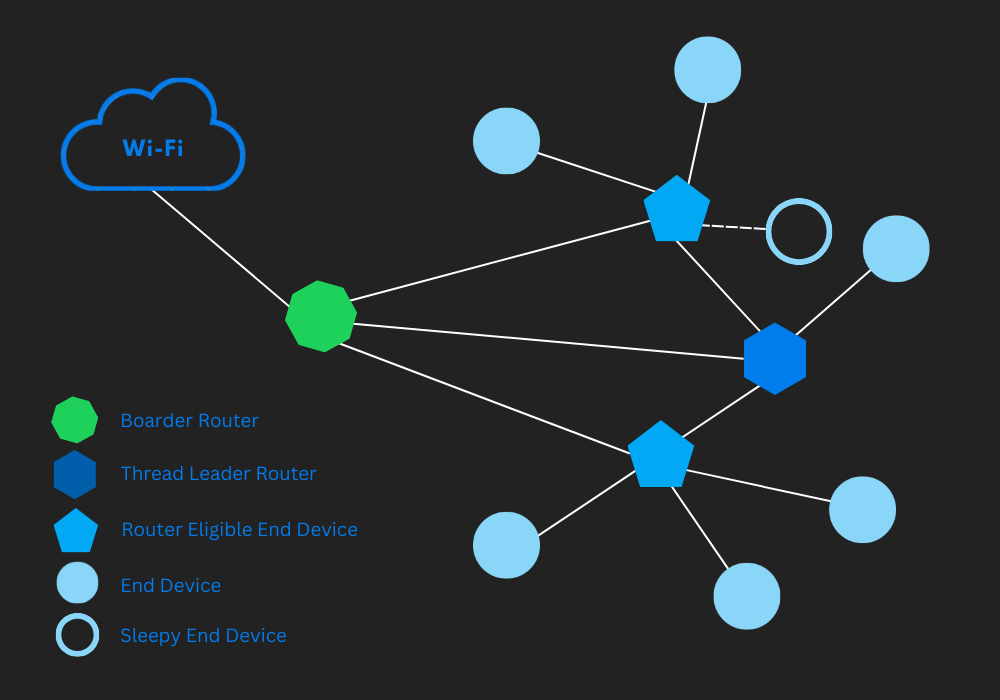
Thread mesh has got endpoints and routers. Endpoints are any device we wish to control, basically all the battery-powered devices.
The router is the next level of a Thread mesh network. They are responsible for creating the mesh network to which all endpoints are connected and the routing of data packets between end devices. Unlike Wi-Fi routers, a Thread router can be an end device that you want to control, called Router Eligible End Device (REED). A Thread has a Leader router and multiple border routers. A leader router is responsible for managing other routers in a Thread network, whereas a border router is a device that can forward information between a Thread network and a non-thread network (Wi-Fi).
Conclusion :
Matter offers a promising future for the development of smart products, ensuring standardization, security, and interoperability for a more transparent and efficient smart home environment. Like any emerging technology, Matter will also be evolving to meet the needs of end users.
Thank you note !
I want to personally thank you for reading my article. Your time and attention are greatly appreciated, and it means a lot to me that you took the time to engage with my content.
Your support and feedback are invaluable, and I am grateful for the opportunity to share my thoughts and ideas with you. Whether you left a comment, shared the article, or read it, your participation helps fuel my passion for writing and motivates me to keep creating content that resonates with readers like you.
Please feel free to reach out if you have any thoughts, questions, or feedback about the article. I love hearing from my readers and learning about your perspectives.
Once again, thank you for your support. I look forward to sharing more with you soon.