 EN
EN FR
FRHello !
Wireless communications are the transmission of data without cables or wires and are the heart of the IoT.
In our daily lives, we all use different wireless communication standards for various purposes but have little idea what these communication systems are. Wireless communication devices can speak different languages, often referred to as protocols. Have you ever wondered why there are so many wireless protocols instead of one universal protocol for all industrial standards?
Wireless protocols are designed to provide a set of characteristics desired by industries, they are- frequency, power usage, range, data rate, etc.
Types of protocols :
A private company owns a proprietary protocol and makes use of proprietary software for implementation. These protocols are often restrictive, and only supported by that company’s devices. So, the customers must install devices from the same company due to compatibility issues. On the other hand, an open protocol uses open-source software instead for implementation. It is freely available for different producers to integrate into their products to work with each other. Open standards are always gaining popularity in the present trend because of the openness in compatibility and interoperability. Both Wi-Fi and ZigBee are examples of open standards.
Okay, enough with the introduction. Let's take a closer look at the two most popular protocols we use in our smart home installations: Wi-Fi and ZigBee.
Wi-Fi :
Unlike wired protocols, wireless systems use radio spectrum waves to create a network of interconnected devices. These networks are set up to carry data between participating devices at certain frequencies and bandwidths.
As far as networks are concerned, we are already familiar with the concepts of WAN and LAN. While LAN connects users within a small area like a building, WAN connects users across the globe. When devices are wirelessly connected to form a LAN, it is called wireless LAN (WLAN).
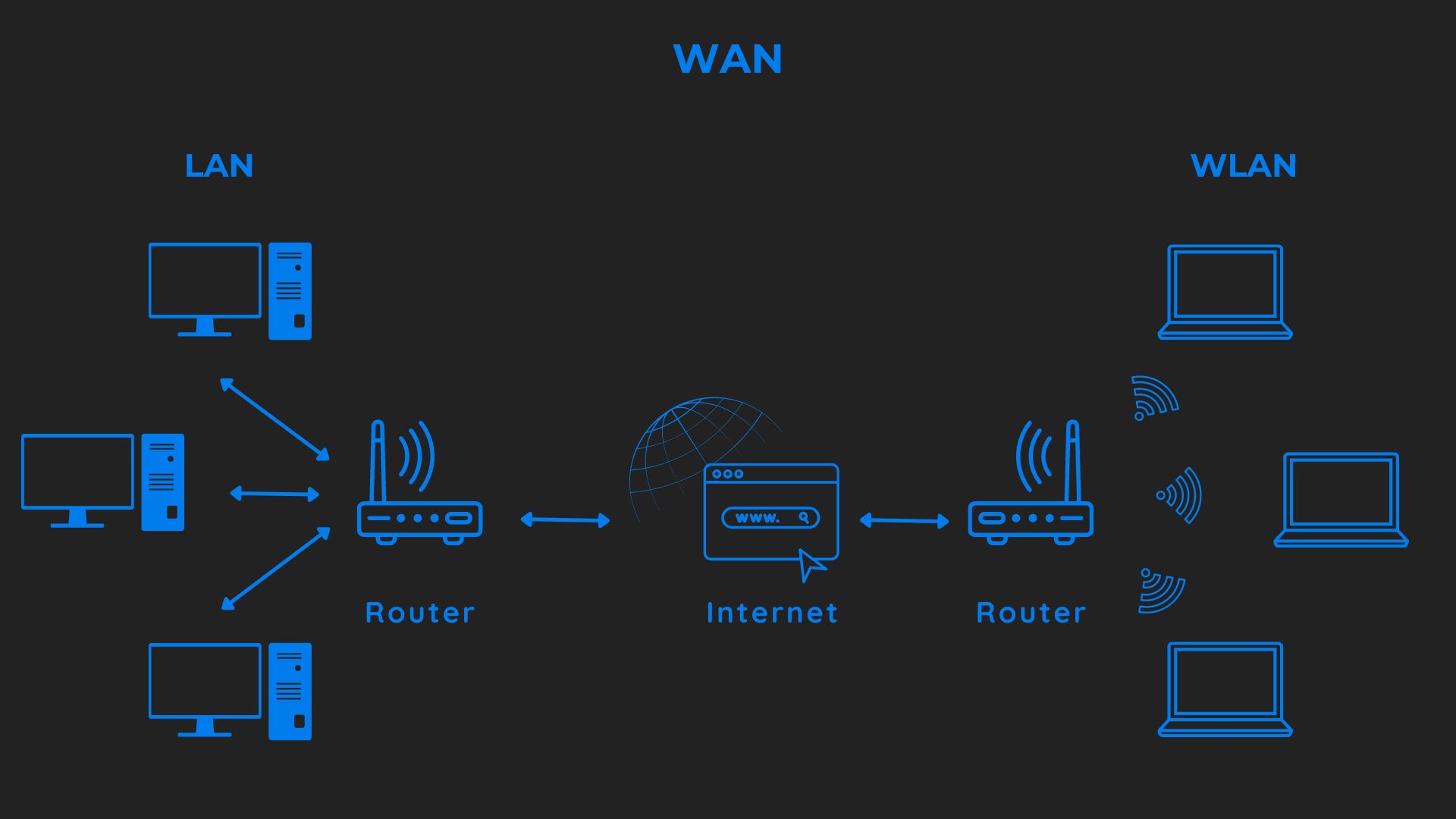
We are all familiar with the ‘Wi-Fi’ protocol, a WLAN technology that is widely used in the smart home sector because users don't need to buy a separate central controller (Hub) to create and manage the network for the smart devices, the network router itself will do that job.
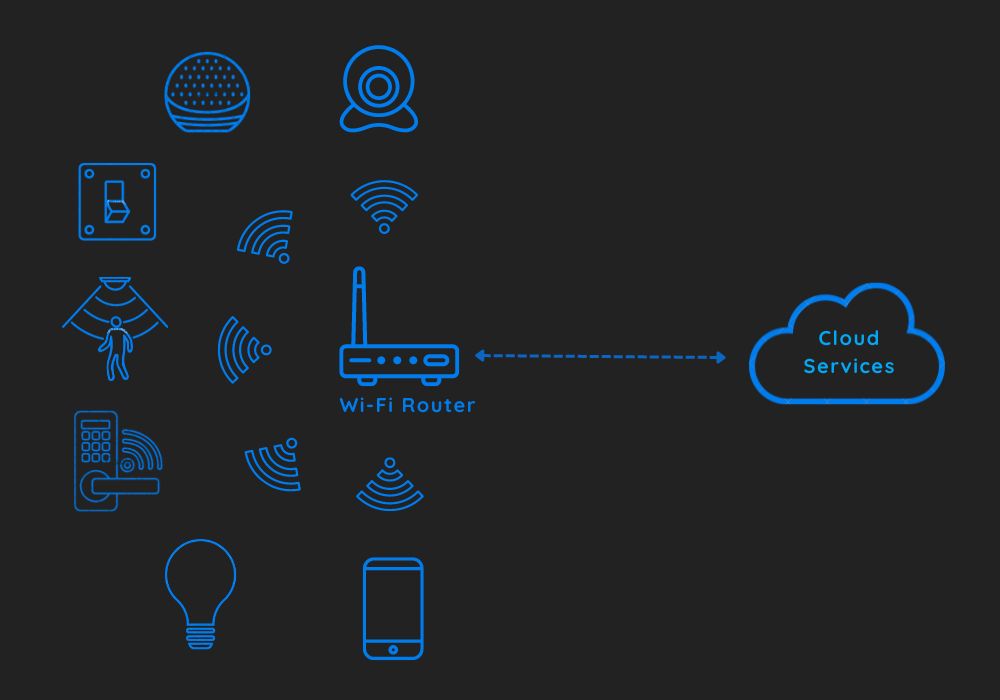
Although Wi-Fi is a widely used wireless communication method, it is not intended for smart devices, especially when they run on batteries. That's what a lot of people have said, but why?
First, we should talk a little about IEEE standards. IEEE standards are fundamental to the development of electronic, electrical, and mechanical devices by establishing consistent protocols that can be universally understood and adopted.
IEEE has various formats, and one of the most notable is IEEE 802.11, which is responsible for implementing wireless local area networks (WLANs) and facilitating large-scale data transfers. This increased bandwidth always comes with a price to pay, high energy consumption. So, Wi-Fi is suited for main-powered IoT devices that require high bandwidth such as security cameras, smart speakers, and smart TVs, but not for battery-operated devices like sensors. Also, Wi-Fi devices always rely on cloud service to function.
If not Wi-Fi, then what ?
The smart home approach is slightly different than the WLAN. Instead, it uses the Personal Area Network (PAN), which links devices in an individual's personal space. The size of the PAN network varies from a few centimeters to several meters. The wireless version of PAN is called WPAN. WPAN is defined by IEEE 805.15 and has 7 task groups: WPAN/Bluetooth, Coexistence, High Rate WPAN, Low Rate WPAN, Mesh Networking, Body Area Networks, and Visible Light Communication.
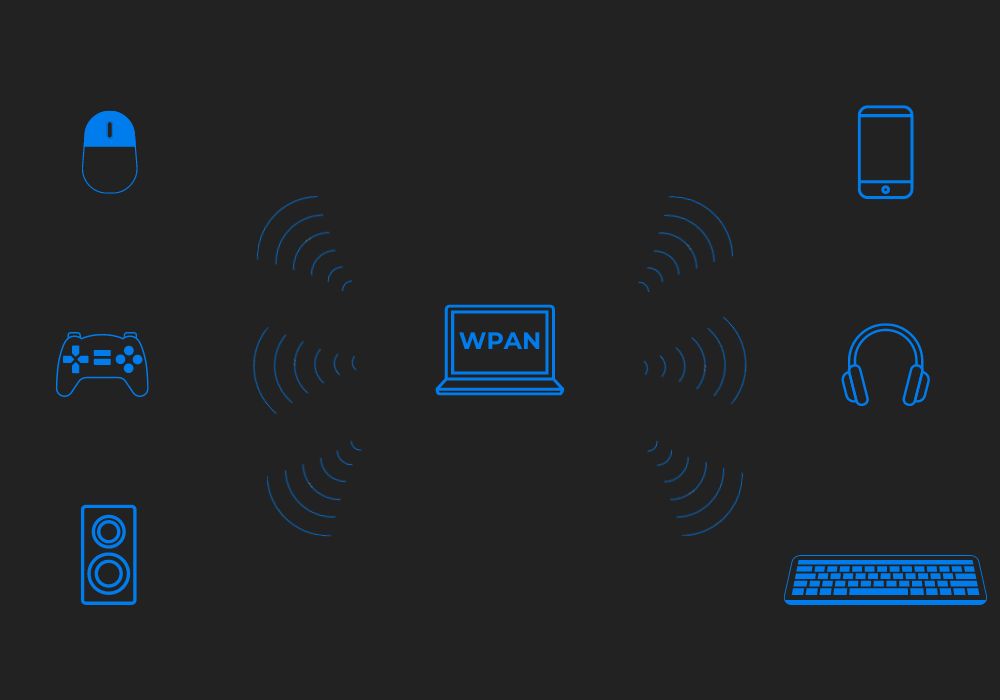
Task group 4 (IEEE 805.15.4) is currently being used to support a low data rate solution with several months of battery life and very low complexity, including ZigBee, 6lowPAN, and TinyOS.
ZigBee :
ZigBee is a popular low-power, low-data rate wireless (Low Rate WPAN) mesh network technology based on the IEEE standard 802.15.4. ZigBee uses 2.4 GHz (all over the world), a 915 MHz frequency for North America and Australia, and an 868 MHz frequency for Europe.
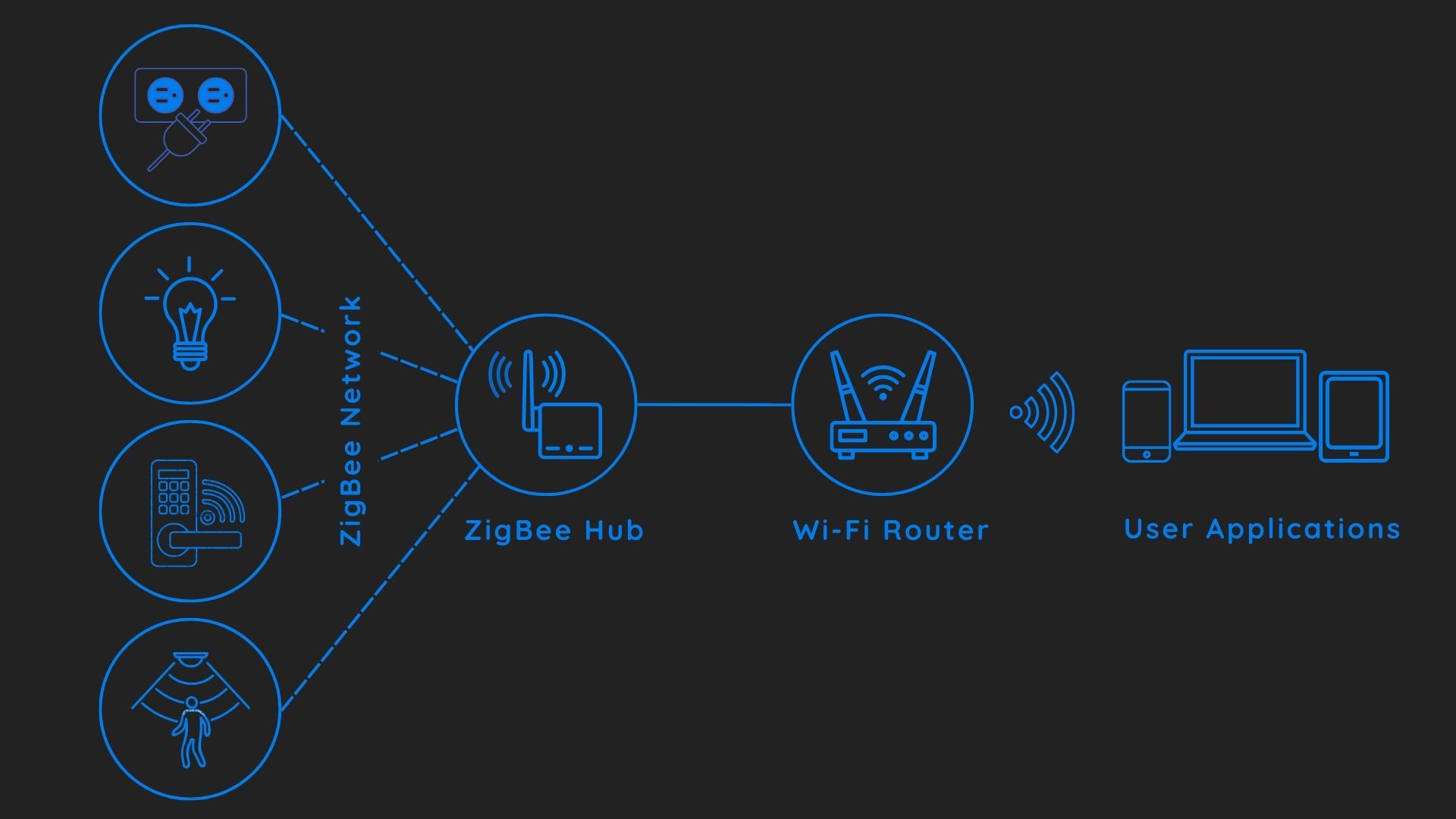
ZigBee devices fall under three defined types- a Zigbee Coordinator, a Zigbee Router, or a Zigbee End Device.
The coordinator creates the network in the first place and stores all the security keys. This is usually a hub or smart home controller (like Amazon Echo devices).
The router is a Zigbee device, capable of extending the network to a greater distance from the controller. This is usually a mains-powered device, as it is an active network device.
An end device is a basic device that requires less power and memory to perform its functions. To ensure the battery lasts as long as possible, terminal devices will be in sleep mode when not in use.
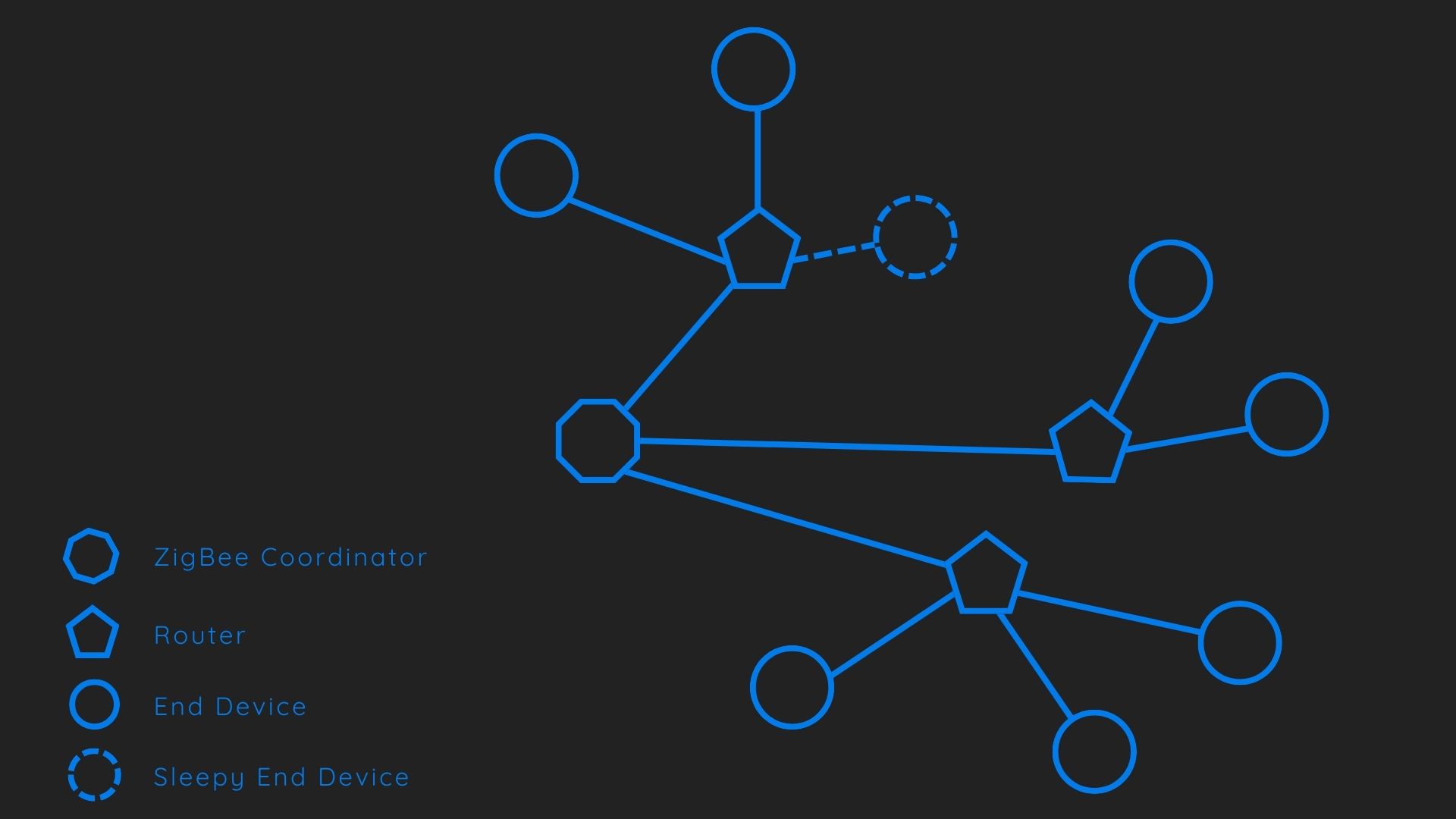
The features that make Zigbee desirable for the smart home are as follows :
- Flexibility : Supports multiple network topologies such as point-to-point, point-to-multipoint, and mesh.
- Low duty cycle : Lower power consumption provides long battery life.
- Low latency : Can easily transport data between nodes with minimal latency.
- Scalability : Support Small and Large Networks. Up to 65000 devices (Theoretically), 240 devices (Practically).
- Reliability : Employs CSMA-CA to ensure that data is delivered reliably even in adverse conditions.
- Low data rate : 20-250 kbps.
- Security : Zigbee uses 128-bit keys and the AES encryption standard.
Wi-Fi and ZigBee Coexistence :
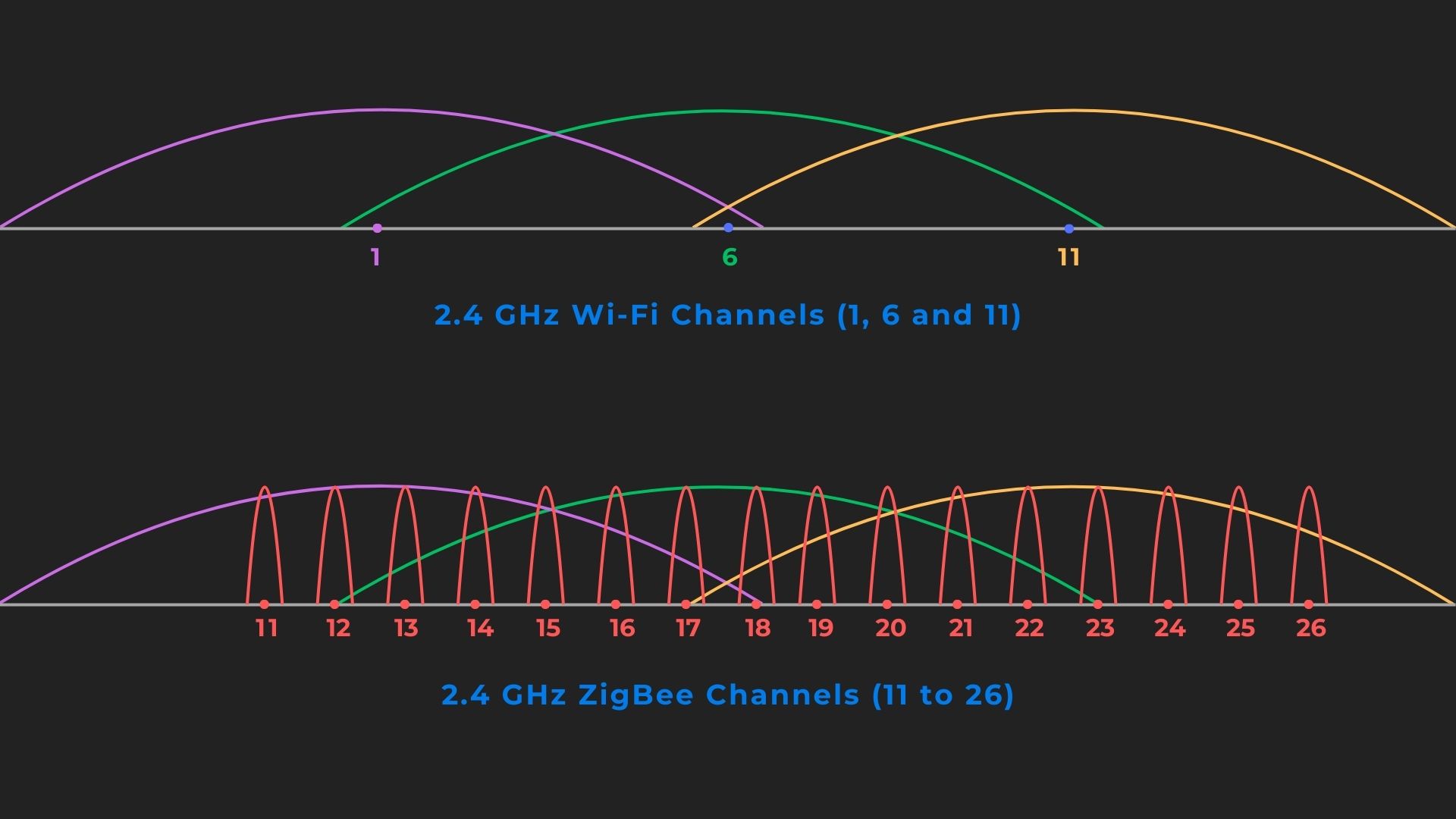
The most common frequency band for Zigbee is 2.4 GHz same as Wi-Fi but with narrow channel bandwidths. Therefore, when a ZigBee network and a Wi-Fi network operate on the same frequency, it is important to plan the channels correctly to avoid interference between them. Otherwise, the ZigBee network suffers since it is a low-bandwidth protocol.
For the 2.4 GHz band, Wi-Fi most often uses channels 1, 6, and 11, which do not overlap. ZigBee, on the other hand, uses channels 11 to 26 in the 2.4 GHz band. The figure below shows that the three non-overlapping Wi-Fi channels 1, 6, and 11 use the same frequencies as ZigBee channels 11 to 26.
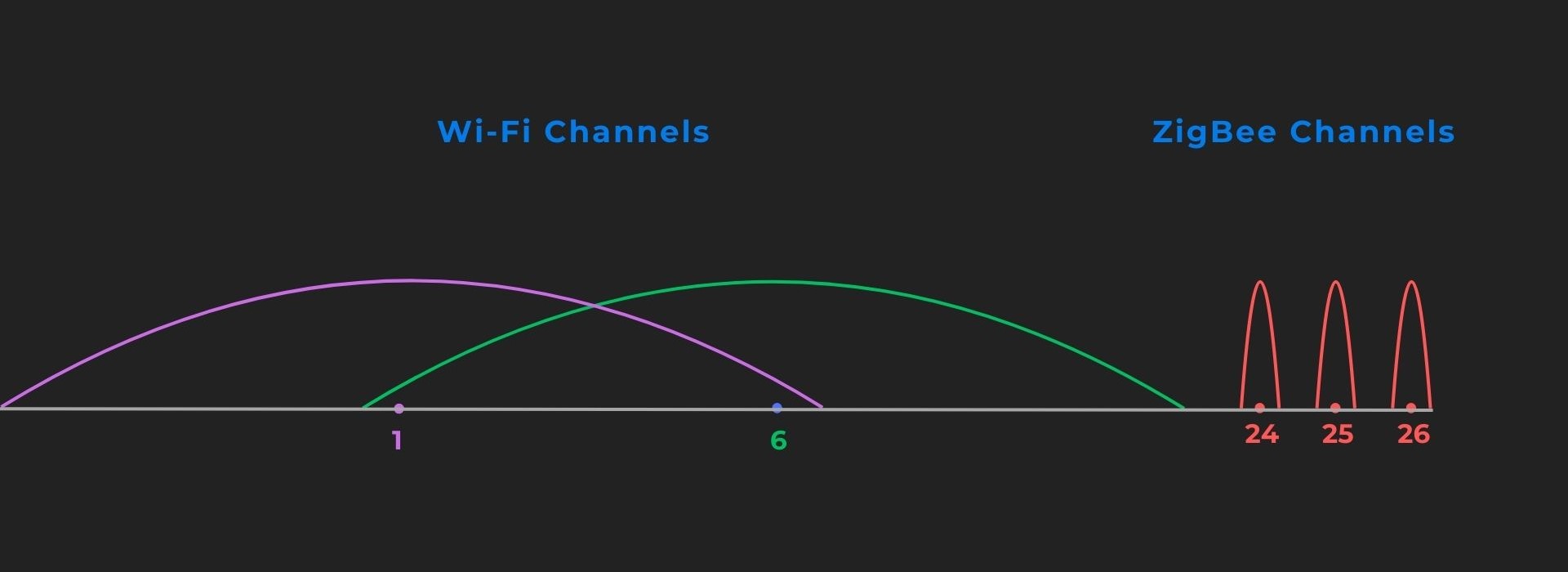
If you give up the Wi-Fi channel 11 ZigBee can use channels 24 and 25 without any interference from Wi-Fi. ZigBee channel 26 is not used by many ZigBee devices, but Aqara products support channel 26.
For example, if your ZigBee network only includes Aqara devices, choose channel 26, but if the devices come from different manufacturers, it is advisable to use channel 24 or 25, preferably Ch 24 since almost all ZigBee products support this channel.
Conclusion :
If you want to transmit more data more quickly, Wi-Fi is more suitable. Wi-Fi also offers a more secure connection.
The Zigbee protocol has much slower speeds than Wi-Fi, but this means that devices consume much less energy. Thanks to the mesh network, an intelligent home system equipped with Zigbee devices can synchronize more consistently and benefit from more extensive connectivity. ZigBee is always the better choice for small battery-operated devices.
Thank you note !
I want to personally thank you for reading my article. Your time and attention are greatly appreciated, and it means a lot to me that you took the time to engage with my content.
Your support and feedback are invaluable, and I am grateful for the opportunity to share my thoughts and ideas with you. Whether you left a comment, shared the article, or read it, your participation helps fuel my passion for writing and motivates me to keep creating content that resonates with readers like you.
Please feel free to reach out if you have any thoughts, questions, or feedback about the article. I love hearing from my readers and learning about your perspectives.
Once again, thank you for your support. I look forward to sharing more with you soon.